

5 Things I Learned from Finishing My First Draft

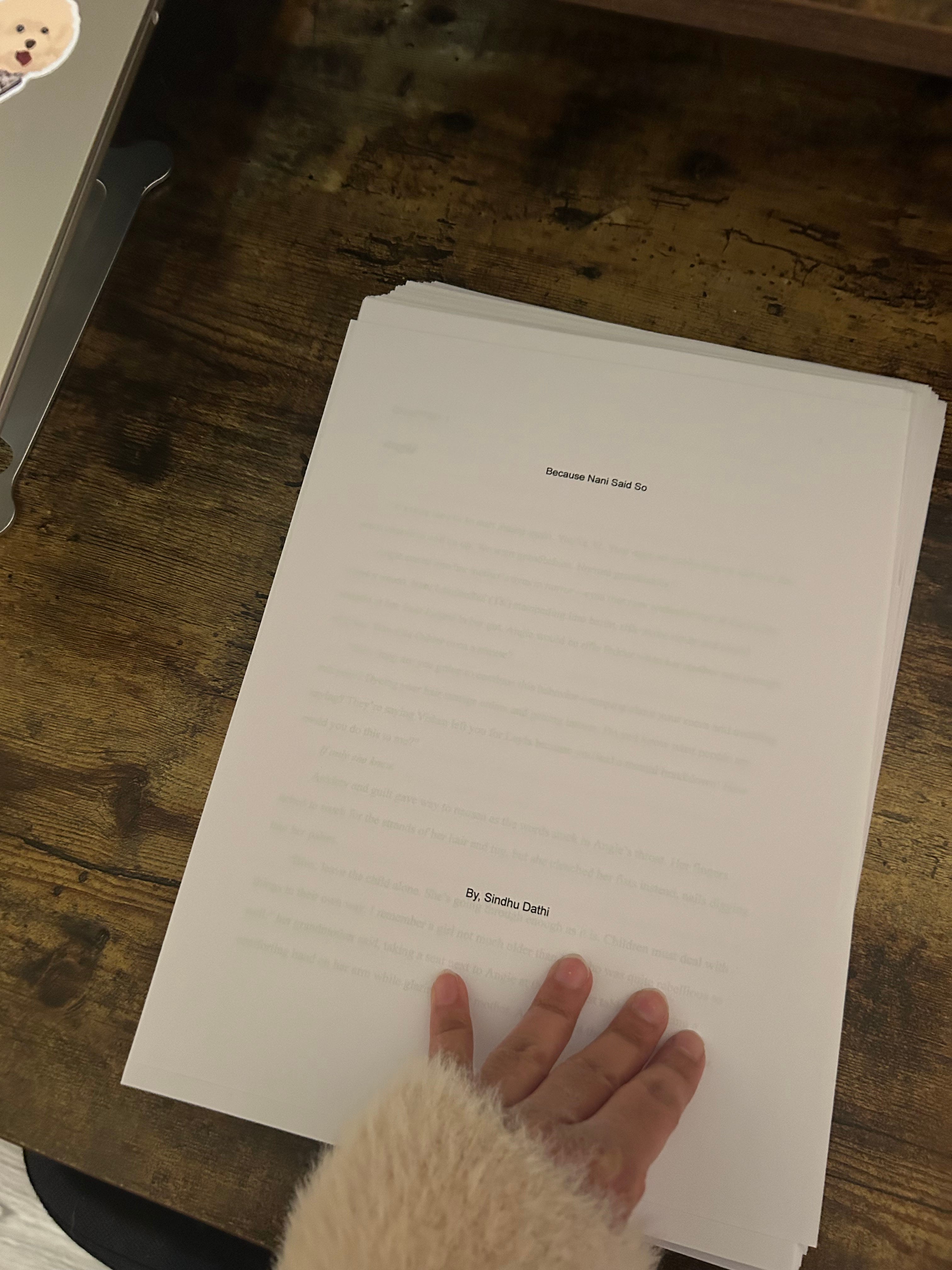
Finishing my first draft took 3 years, 3 months, and more mindset battles than plot twists.
Here are five lessons I wish someone had told me before I started.
Whether it’s before you start writing or after, you will need to outline your story
Before my fellow pantsers start taking out the bullhorns and rioting—hear me out.
I have always been a pantser.
Want to know how many first drafts I’ve finished? One. And despite that I’m proud of myself for finishing, there are plot holes galore that I’ll need to go back and address in my first edit, because while I had an outline—I chose not to follow it.
That ended in:
Plot holes
Incorrect timelines
Changing backstories
Pacing issues
When you have an outline, you reduce or eliminate these problems because you know what information needs to go where.
Whether you choose to outline before you start your novel, or reverse outline afterward to check for the issues above—is up to you.
What I can tell you from experience however, is that it is far quicker to outline beforehand than to go back and fix all your developmental issues afterwards.
Yes, you’ll have to edit your novel anyway. But only you know how much you’ll have to edit and how long it will take you. So sit down, consider the pros and cons of both methods, and pick one. Your choice will dictate the journey.
Mindset is the biggest blocker between you and a finished first draft
Limiting beliefs tend to loop in our minds.
The same limiting beliefs that were planted there by that one well-meaning English teacher that didn’t realize how much harm they’d be doing by telling you to prepare for brokenness if you followed the path of a writer.
The ones planted by your parents every time they suggested you choose the safer career path—one with a steady paycheck.
This is the number one reason why your draft is still sitting at 9,876 words after two years. And please don’t take this as a criticism—it took me 3 years and 3 months to finish my first draft and the first year or two it stayed stuck at three chapters.
Even after pitching an agent who requested my full manuscript at first query—I chickened out and didn’t pick up my work in progress again for almost a full year. Why? Because the thought loops were strong.
It’s not always obvious. It doesn’t always come in the form of audible voices in your head screaming at you. It’s not always a voice that sounds like you yelling “You suck!”
Sometimes it’s barely a whisper.
Sometimes it’s just a feeling in your chest. A feeling of stuckness. Like there’s a thorn burrowed deep in your chest and you can’t start writing until it’s gone.
Sometimes it comes in the form of an action. In the way you pick up your phone and start scrolling when you should be writing. When you decide you need to do laundry at that moment. When a text you didn’t feel the need to answer ten minutes ago suddenly demands your attention.
Sometimes it’s all so subtle, you’re not even aware of the puppetmaster pulling the strings.
But let me tell you a secret.
When you know the puppet master is there—when you see him pulling the strings—it takes the power away.
Similarly, when you become aware of the thought loops—when you become aware that thoughts are not always facts, and make the choice to ignore the voice—that’s when you start walking down the road to finishing your draft.
You don’t need to know everything about your story right from the start
The first draft is about exploration. It’s about getting to know the story—the real story—and getting to know your characters.
I spent three years with my characters. I’d like to think that I know something about who they are by now.
Hell, I know more about them than their own parents, lovers, and selves. And that is more than enough to edit a book.
In the beginning though… in the beginning, the answers to many of these questions are just that. Questions.
If you want to take the time to understand all the details beforehand—that’s fine. But it’s not necessary. Because while you sit with them, watch them, hear their whispers, follow their actions—the characters become real in a way that they weren’t before. They start to tell you who they are or their actions bring up questions about what details are relevant—what details are important for you to really know.
Scenes should be intentional
Every scene, every line, has a place. A reason for existing in the space of your novel.
Scenes should:
Explore the theme
Advance character change
Reveal meaningful backstory
Increase tension or stakes
Develop relationships and dynamics
Move the plot forward
And if it doesn’t do one of these things? You should be asking yourself why it exists.
There’s a reason that everyone always skips the filler episodes in Naruto and Bleach (for any anime watchers who understand this reference). Because if it adds nothing to the story, then why turn the page?
Your critique group will be your biggest advantage or detriment
I have never liked critique groups.
My first experience with critique was in my college creative writing class. The professor never taught us how to critique—just to read the stories and say what we thought worked and didn’t work. That is very vague instruction—escecially for a group of incoming college students wanting to prove themselves to be the next great American novelist (or romance writer in my case).
Which, of course, meant that a lot of the time, stories got ripped to shreds.
Up until this point, I was under the impression that I was a good writer. I’d been writing fanfiction since middle school and I had a small but consistent following. A play I’d whipped up in the last ten minutes of class had been selected to be filmed by the drama club in high school. I’d even won a poetry contest or two.
Surely this meant that I could write, correct?
By the end of four years in my Creative Writing minor, I wasn’t so sure.
Critiques are meant to be constructive. But it’s also important to remember that they’re subjective—based purely on the reader’s experience and preferences. Which means you can take what works and leave what doesn’t.
I learned none of this.
To me, all I saw was pages and pages of red ink. Red ink that spelled out ‘Not good enough’.
I entered college dreaming of being a writer. I left college a teacher.
It’s a part of my life I wouldn’t change. Teaching taught me a lot. Still, I gave up writing for nearly a decade. I wrote in spurts here and there but it was like the light had gone out.
The wrong critique group can kill a writer’s soul. Their spirit. I firmly believe that.
But the right one… the right one can salvage what’s left of it. Can reignite that spark of something that’s threadbare, flickering, but yearning to be re-lit.
I found my critique group through reddit. Someone posted about a romance writers discord group, and because my luck with general critique groups up to this point had been shit, I thought I’d have better luck in a romance-specific group.
I did.
I met three other romance writers who became my rocks. This draft would still be stuck at 9,876 words if not for them.
We’ve been meeting every Thursday for over a year now. We became familiar with each other’s plots, writing styles, strengths and weaknesses. They were invested in my characters, and I was invested in theirs. We cheered for them, were angry at them, gave praise when it was due, and told each other honestly when something didn’t work.
And slowly, my post-critique PTSD started to heal.
If you are one of those with critique group trauma who hasn’t found them yet—trust me when I say they are out there.
You just haven’t found them because it’s not the right moment, fit, or group.
The Finish Line
Finishing a draft doesn’t mean you’re done. It doesn’t mean you’re a perfect writer. But it does mean you didn’t quit. It means you’re capable of sitting down and working towards something that’s important to you.
It means that instead of prioritizing the cell phone, the laundry, your job, your kids, your dog, the taxes—you chose you.
Such great insights and lessons. Congrats on finishing your first draft!!! :D