

The Compromising Position Scene
My Story Grid Mentorship

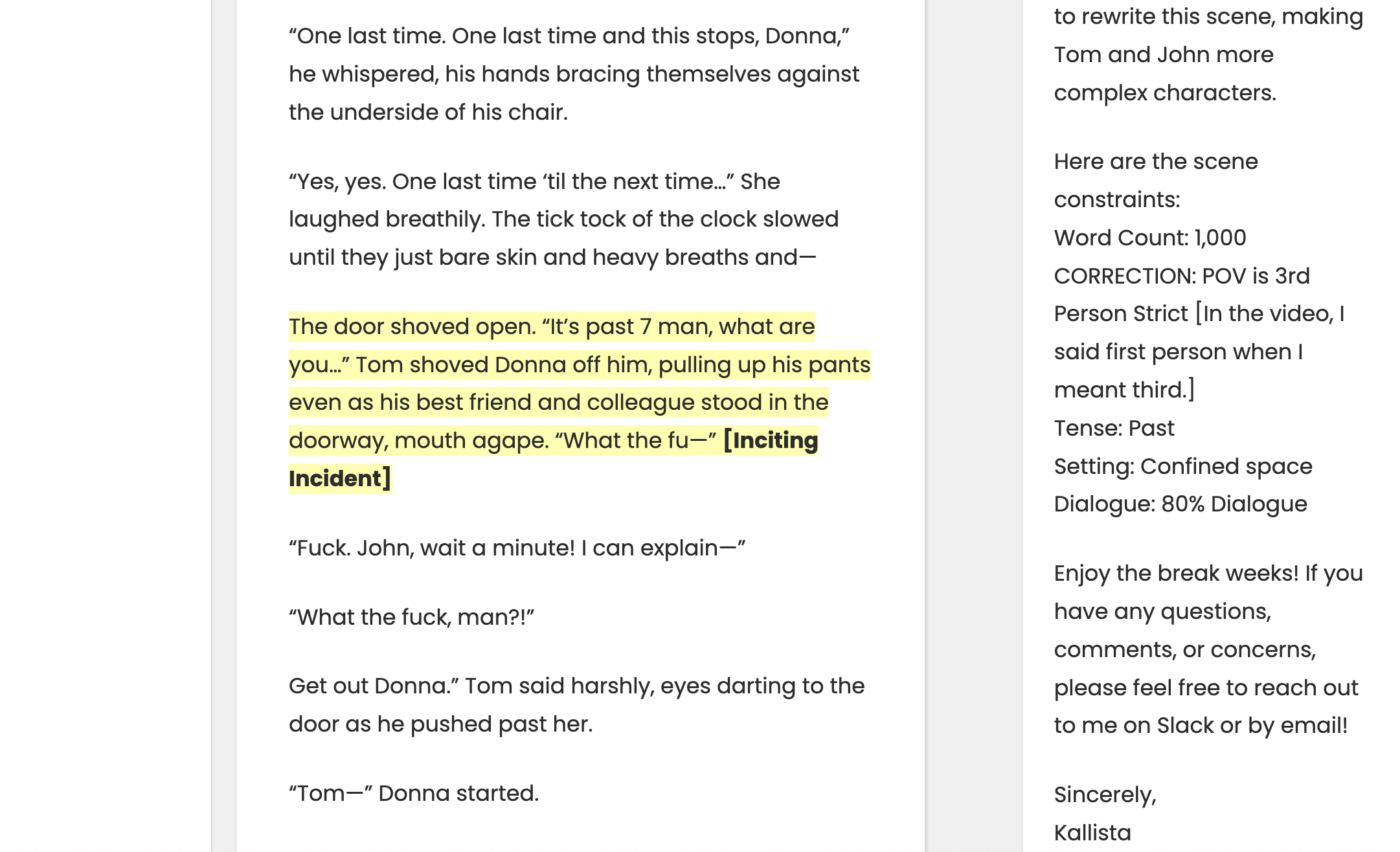
Last week, my developmental editor, Kallista, asked me to write a Compromising Position scene—one where the protagonist does something the group disapproves of and gets an ultimatum.
I knew I would hate writing it.
In my head, if a character is caught doing something the group disapproves of, they’re obviously in the wrong. (No matter that sometimes the group is in the wrong—subconscious me obviously disagrees). So I went with the most obvious option: cheating.
I knew what the scene would sound like before I started typing. Mostly because I gave zero shits about these characters.
I wrote it anyway. I even fulfilled Kallista’s requests this time.
The problem?
The characters were flat.
When we discussed it, I told her I’d hated writing the scene and wasn’t surprised it didn’t work. When she asked why, all I could come up with was that I didn’t connect to the characters—and that I would never choose to write a scene like this on my own.
My main characters aren’t bad people. They wouldn’t do something I personally disapprove of. But maybe that’s the problem. The second I decided this character was going to cheat, I stopped seeing them as mine. I refused to get to know them because I had al
ready judged them.
Because if I write characters who do bad things—and actually like them—what does that say about me?
Yes, I’m aware how warped that sounds. And no, I don’t believe every person who does something bad is bad—at least not consciously.
Regardless, I started the scene already disconnected. I didn’t try to like the character. Why would I invest time and emotion into someone I knew was about to do something I disapproved of? This clearly wasn’t a craft issue. It was a mindset issue. I didn’t want to write a character with such a deep flaw. And if they had one, I pushed them into antagonist territory—a role I associate with people I don’t like and don’t try to understand.
Which is a problem. Characters should be complex. Just like people.
They make mistakes. They do good things and bad things.
I’ve always told myself I don’t want to dwell on the darker parts of human nature. I want my protagonists to be likable.
But humans are flawed. I’m no exception.
A friend of mine told me recently that people are either curious or judgemental. I’ve clearly been the latter, when good writing requires the former.
Even in romance, people mess up. And being willing to explore it when they do can only deepen empathy and strengthen the writing.
This has been a challenge for me. But awareness is the first step, right?
Try it out
Want to try this scene yourself?
Here are the scene constraints:
Word Count: 800
POV: 3rd Person Strict [Only actions and dialogue; no internal dialogue]
Tense: Past
Setting: Confined space
Dialogue: 80% Dialogue
Here’s the structure:
Inciting Incident: The protagonist is discovered doing something disapproved of by the group.
Crisis: Status Dilemma
Climax: The Protagonist gives in to the group or stands their ground
such an interesting reflection on how we put so much of ourselves into our characters. I've also struggled to write "bad" people because of the ways in which my brain turns itself inside out thinking about how that character will be perceived, what it means that I can tap into a negative trait in that way, etc.