

Why My "Perfect" Romance Scene Failed
Scene Feedback from my Story Grid Mentor

I am a Story Grid mentee. A fact I’m learning to show more enthusiasm about—even when the red ink starts flowing.
Focusing on writing is a dream—and a privilege. And this year, I decided to gift myself that privilege.
A whole year to write, to develop my craft, to follow my dreams.
As an aspiring author with a serious case of delay delay delay until I’ve done enough research, improved enough, to convince myself that I’m a decent enough writer to complete my novel—I joined Story Grid.
I don’t recommend or believe that every author needs to run off and join a $5000 mentorship program to succeed. Especially if you have financial constraints.
I joined because after getting axed from my job last year, my imposter syndrome was huge—and I feared that it was keeping me from taking the action I needed to do to become an author—to sit down and actually write.
I joined because I have the time, finances, and ability to devote myself to myself for a year.
So that’s what I’m doing.
What Is Story Grid?
If you haven’t heard of Story Grid, it’s a tool and program that allows authors to level up their craft game.
As a part of their one-on-one mentorship program, you’re paired up with a mentor, your personal developmental editor, who works with you for a minimum of four months to identify your weaknesses, and develop your writing skills.
Each week, we’re assigned a scene to work on or revise with specific scene constraints.
This week, my mentor gave me a scene called “Take a Chance on Me”—a scene where the antagonist asks the protagonist out on a date.
As a romance writer, I was excited for this —especially since my first assignment was a chase scene—which I hated. This one, however, was my domain. I live and breathe romance, so of course I’d do well at it. Or at least better than I did writing the chase scene.
And, I did do better. Of course, I did. Because I wrote a scene that would be funny to me. My ideal reader has always been myself, not anyone else. The problem with this mentality is, as far as the mentorship is concerned, the goal is to write for someone else—my mentor.
And as far as Kallista was concerned, yes—she laughed in the right places but I still fell short of what she asked for.
But if she laughed, what’s the problem, right?
The problem was that I knew exactly what she was going to say before I even hit submit. I hit it anyway.
I’d written a story in my head that said “they obviously don’t know romance and not every scene needs a huge crisis,” or “this scene is great as is” and “I don’t want to re-write it and make it worse by doing what they ask”. The loop went on and on and I folded to my ego instead of just following the directions.
The Five Commandments
So where did I fall short? How did I know my scene didn’t fulfill the scene requirements? Because every scene is required to follow Story Grid’s five commandments for a good scene.
In other words, every scene we write must consist of:
An inciting Incident - the incident that starts the scene—aka the first moment the antagonistic force puts pressure on the protagonist, taking their attention away from their goal or desire.
A Turning Point - the moment the protagonist refuses to go along with the antagonist’s whims.
A Crisis - the protagonist must make a decision between two options of equal weight, both with significant stakes.
A Climax - the protagonist acts on the decision they made during the crisis. This is when all the tension and stakes you’ve built pays off for the reader.
A Resolution - the aftermath of the protagonist’s decision.
My scene had a beginning and an end, but I was missing the “middle” that makes a story actually work.
The Scene Constraints
The structure:
Inciting Incident: Antagonist asks the protagonist out on a date.
Crisis: Trust Dilemma
Climax: The protagonist either accepts the date or declines it.
The constraints:
Word Count: 500
POV: 1st Person Strict
Tense: Present
Balanced mix of Dialogue and Physical Action
Setting: Performing a physical task (e.g., washing dishes, walking)
My Scene
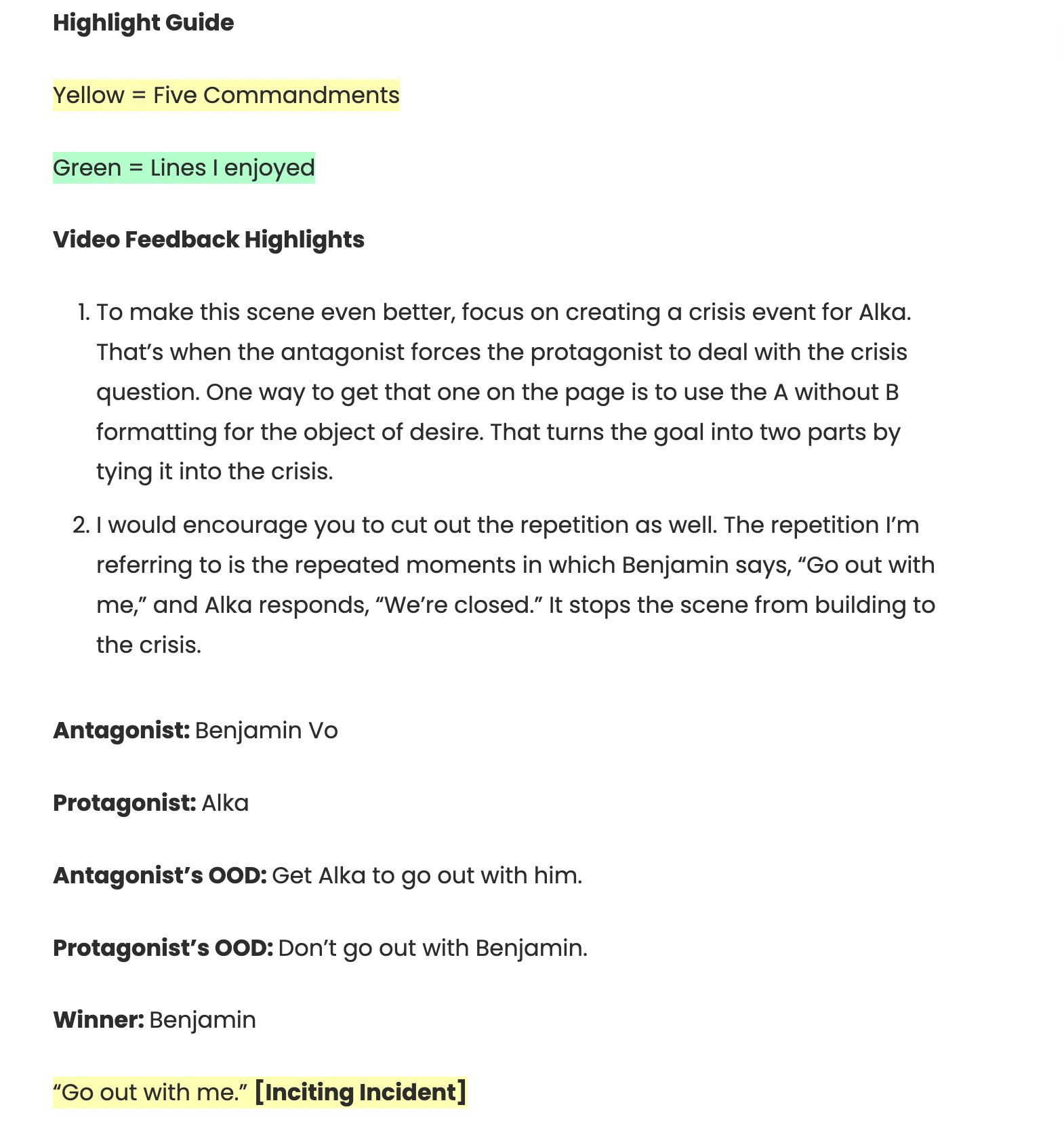
“Go out with me.” [Inciting Incident]
I scowl at the too tall for his own good, too dark, too handsome and far too egotistical asshole currently standing in the middle of her empty hair salon at seven minutes to closing.
“We’re closed.” I sweep the floor around his legs, making sure to swat at his tailored pants with the end of my broom in the process. Benjamin Vo has the nerve to glare, as if I’m the one intruding on his space. This is why I hate lawyers, I think. I sweep a pile of hair that was lying beneath the swivel chair particularly roughly in his direction, smirking when the curly locks cover his brown leather lace ups, making a mess of them.
Ben’s lips turn downward as he stares at the shoes that no doubt probably costs the equivalent of my entire monthly rent on the salon and apartment combined. I almost gag at the thought and swat at him with the broom again, but unfortunately, he dodges this time. “Problem, Benjamin?”
“Problem? Why would there be problem? It’s not like these are Ferragamo.” He mutters, grabbing a tissue from the countertop behind me and brushing the hairs off his shoes.
I roll my eyes. Asshat.
“Go out with me,” he tries again, throwing the tissue into the trash behind me.
“We’re closed,” I respond immediately, gesturing to the schedule posted on the door.
“No, you’re open until 8pm. Now go out with me.”
“It’s four minutes to closing, Mr. Vo and time is money, so I’d appreciate it if you would get out and let me close up.”
“Oh, for fuck’s sake…” he mutters, side-stepping my broom and sliding into the salon chair. “Cut my hair then.”
I stare at the hot asshat, confused. “What part of “we’re four minutes to closing did you not get, Mr. Vo?”
“I’ll pay you double your rate, okay?”
“Triple. You can afford it,” I say after a moment, eyeing his shoes.
He glowers at me, “Fine. Triple.”
I prop the broom against the wall and grab the scissors from my supply desk before making my way over to him. His hair is soft, healthy, free of gels and oils. It’s that thick, black hair that makes women drool and men jealous. I love it and hate it at the same time.
“Go out with me,” Ben asks again.
“I’d rather chew my toes off and eat them, Benjamin,” I say, chopping off another lock of hair. It physically hurt to cut it. I like the way it falls into his eyes and—
“Our best friends are getting married Alka. Which means we have to start getting along. So, let me take you out and prove that I’m not that bad, would you?”
I consider it. “One date. Two hours max. And you’re paying,” I say finally, cutting another lock. [Climax]
Ben rolls his eyes, but I see the makings of a smile at the corner of his lips. “It’s a date,” he murmurs. [Resolution]
The Feedback
Kallista’s feedback was as expected: she enjoyed the humor, but the scene was repetitive. Alka repeated “We’re closed” over and over—something I did intentionally to create humor. But humor doesn’t drive a scene; conflict does.
And you can’t build conflict through repetition—especially with limited real estate.
The scene was funny, but felt like the beginning of a much longer scene.
I wasn’t meant to think of this as the beginning part of a 2000 word scene—the 500 words was the complete scene. Which means every word must be thoughtfully chosen to create the full scene arc.
By the time we got to the climax, Kallista was left wondering why Alka changed her mind. Because I skipped the turning point and crisis, she couldn’t follow the character’s logic—couldn’t be emotionally there with the character at the moment of her decision. I was so focused on humor and building likable characters, that I forgot what needed to be there to make the scene work.
I struggled with this feedback because I’ve read plenty of scenes where there is no clear crisis or turning point—especially in romance novels. Or rather, I thought I’d read scenes without them. In reality, the best ones just hide the machinery so well I didn’t notice it.
What I also missed was that Kallista had given me this assignment not because every scene has to have some outrageous life or death crisis, but to challenge my ability to create a crisis within the limited constraints given so that I can build my ability to do so in a longer scene later.
Kallista’s feedback taught me a lot, and also left me with a challenge—how do I maintain my tone and humor while raising the stakes given the limited word utility? I guess we’ll see!
Hit the subscribe button if you’re interested in the re-write feedback.
Your task: I challenge you to try this scene for yourselves and share in the comments!
This is a great (tough) exercise! I love the voice and banter that comes through so clearly from the beginning. You certainly write tension well, and it's so cool to see the way you and Kallista both break down story structure.